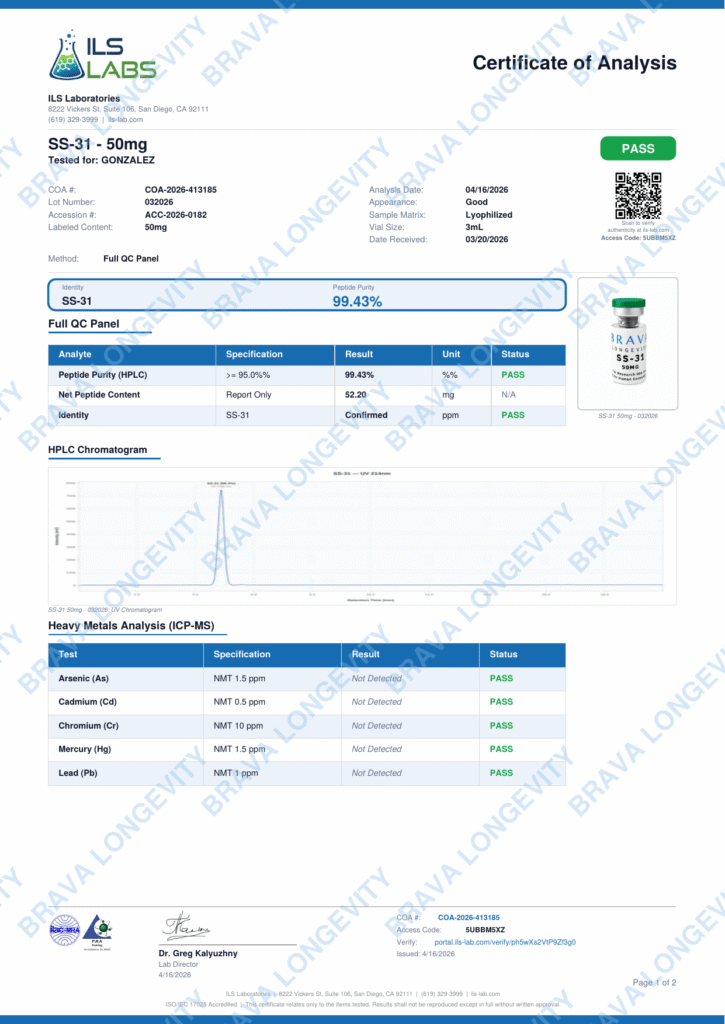
SS-31 50mg — Mitochondrial Signaling & Cardiolipin Research Peptide
SS-31, also known as elamipretide, is a synthetic aromatic-cationic tetrapeptide developed by Hazel Szeto and Peter Schiller at Weill Cornell Medical College. Unlike most research peptides, it does not act through a cell-surface receptor — its alternating aromatic and cationic residues allow it to concentrate directly at the inner mitochondrial membrane, reportedly accumulating there at levels thousands of times higher than in surrounding tissue.
Cardiolipin & Electron Transport Chain Research
The central focus of SS-31 research is its interaction with cardiolipin, a phospholipid essential to inner-mitochondrial-membrane structure and electron transport chain function. Studies have proposed that SS-31 stabilizes cardiolipin’s association with cytochrome c, supporting electron transport and reducing the production of reactive oxygen species during that process (Birk et al., 2013).
Oxidative Stress & Bioenergetics Research
Because mitochondrial dysfunction and cardiolipin disruption have been implicated across a wide range of research models — including neurodegenerative, cardiac, and metabolic disease models — SS-31 has become a common tool compound for researchers studying oxidative-stress pathways and cellular energy production.
Clinical Research Context
Worth noting directly: SS-31 (as elamipretide) is one of the few mitochondria-targeted peptides to have reached Phase II/III clinical trials, studied in conditions including Barth syndrome and primary mitochondrial myopathy. It is not FDA-approved for any indication. In the U.S., it is available strictly as a research compound.
Best For: Mitochondrial / Oxidative Stress Research
For Research Use Only (RUO). Not for human or veterinary use. Not a drug. Not intended to diagnose, treat, cure, or prevent any disease.